Friday, February 11, 2022

Cape Horn, bottom of the world - Feb. 9

Cape Horn , bottom of the world - Feb. 9

Cape Horn (Isla Hornas) is the southernmost headland of the Tiera del Fuego archipelago of Southern Chile and South America (or the bottom of the world).

Cape Horn was once a major, treacherous trade route, but the building of the Panama Canal in 1914, deemed it mostly unnecessary for commercial ships. Now it has become a recreational challenge in yachting or the first portion of expedition ship itineraries to Antarctica.

Infamous for its unpredictable storms, churning seas, large waves, icebergs, and wicked winds, Cape Horn, or Isla Hornas, marks the northern boundary of the Drake Passage. More than 10,000 seamen have perished while rounding the Horn. 

Because a bad storm was brewing on the west, our Captain who wanted so much to take us there, sailed through an inner channel to get us there. He took us south into Drakes Passage and all around Cape Horn. Everyone on board was very excited to be passing Cape Horn. Its not something that is a common occurrence. He then headed north on the eastern side of South America into the Atlantic Ocean.

The Cape Horn area is so absolutely remote and so windy, we were shocked to learn that a family lives in the lighthouse, with four young children. You couldn't pay us enough to live there. And of course, we had many thoughts about it. What if someone gets sick? How do they get any fresh food? What if someone wants to go out for a walk?

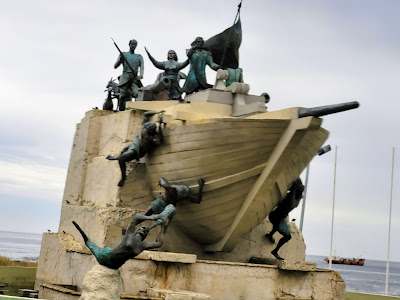
Near the lighthouse is a small chapel and a piece of art depicting the albatross. We couldn't see it clearly, so I took a photo from the internet.

There are many penguins, seals, and whales in the area. We only saw albatross soaring by, as there was poor visibility and it was extremely windy. By the way, albatross are one of the largest seabirds on earth, known for excellent flying skills and wing spans of over 11 feet!

Surprisingly, and perhaps because the captain had filled up the fuel tanks for ballast, our ship was not rocking and rolling at all. A little sway maybe, and later as we got into the Atlantic there was a bit more motion. We have experienced much more rocking and rolling in the Tasman Sea, between New Zealand and Australia, a few years ago.

Another lucky day, because after a successful morning crossing Cape Horn, our Trivia team won and celebrated with mimosas. 

An old sailing legend says that if you are lucky enough  to pass around Cape Horn, you may wear a gold earing in one ear and eat with one foot on the table!! My mah jonng friends tried it at the dinner table 
that night!
 
Also, legend says if you pass around both Cape Horn AND the Cape of Good Hope in southern Africa, you are entitled to wear a gold earring in each ear! For now, we only get one gold earring!!

Light house and dwellings on Cape Horn


Ship's route all around Cape Horn


Internet photo of albatross monument
Mah jonng friends, Connie, Joan, Deb, and Cheryl and spouses

One foot on the table and one gold earring, we earned the right!!

Thursday, February 10, 2022

Beagle Passage (Glacier Alley) and Ushuaia, Argentenia Feb. 9

Beagle Passage (Glacier Alley) and Ushuaia, Argentenia - Feb. 9


On the Strait of Magellan last night near Punta Arenas, our ship was fueling up, but it was too windy to finish. So today we sidetracked to the Beagle Channel, a gorgeous unplanned ride to Ushuaia, Argentina, in order to top off our tanks with an additional 95,000 gallons!!

Argentina is currently closed to tourists due to Covid, but we can still stop for fuel.

Lucky us, because all day we've been treated to eye candy, as we pass magnificent waterfalls, glaciers, and snow capped mountains on the narrow, beautiful Beagle Passage. Another serendipitous bonus.

We've decided that Ushuaia, Argentina looks like a lovely place to visit, as viewed from ship deck. 

Ushuaia, Argentina is the actual southernmost town in the world. Its population is small, around 75,000 people, so its not considered a city, as southernmost city, Punta Arenas, Chile, is. 

Ushuaia is also the world’s most active Antarctic gateway port, receiving over 90% of all tourists that travel to Antarctica.
Beautiful sunset in Ushuaia. 

Big storms are brewing around Cape Horn, so Captain will decide if we are going through Drake's Passage tomorrow. More exciting adventures to come!!
Passed all these beautiful sights while sitting on our balcony.

Was sitting writing in rm, looked up jyst as we passed this site


Ushuaia, Argentina


Argentenian sunset

Wednesday, February 9, 2022

Punta Arenas, Chile, on Magellan Strait- Feb. 7

Punta Arenas, Chile, on Magellan Strait- Feb. 7


Land of Magellan and Magellanic Penguin Colony on Magdalena Island.

Punta Arenas, Chile, is the southernmost city with a population of over 100,000 in the ENTIRE world. Punta Arenas (Sandy Point) is the 4th most windy city in the world, because of the converging of both the Atlantic and the Pacific Oceans.
The narrow sea passage or Strait that Punta Arenas borders is named after Ferdinand Magellan, the Portuguese explorer, who first discovered it and first circumnavigated the globe in 1519.

We toured the Nao Victoria Museum, which contains life size replicas of ships including Magellan's ship, the Victoria. This ship held 48 men, and all survived the expedition. The outdoor museum also had a life size replica of the MS Beagle, sailed by Charles Darwin. Also on display is a lifeboat in which 7 men lived and survived on the legendary island, Tierra del Fuego, land of fire, for 2 years before being rescued.

In addition to Strait of Magellan, Punta Arenas is also gateway to the Los Pinguinos National Monument and the many tiny islands, home to over 120,000 nesting penguins. Magdalena Island has the world's major colony of Magellanic penguins. 

Magdalena Island Penguins
Punta Arenas w our ship in water


Lifeboat held 7 people for 2 yrs

Charles Darwin's ship, HMS Beagle
Magellan's ship, NAO Victoria


2 Glaciers --Amalia and Bruggen Feb. 6

 Amalia and Bruggen Glacier Viewing - Feb. 6

Sunday's scenic cruising took us through the southwest Chilean fjords in Patagonia to the Amalia (Skua) Glacier and then to the Brüggen (Pio X1) Glacier, the longest live glacier in the southern hemisphere outside of Antarctica.  The Brüggen Glacier is one of a very few in the world that is still growing, rather than receding. 

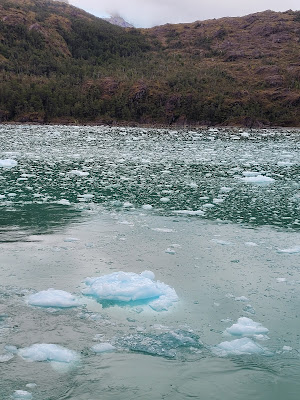
It was a cloudy, misty, at times rainy, but still beautiful day with all sizes of icebergs (bergy bits are the medium size chunks and growlers are the smallest) floating by as we slowly sailed close to each beautiful glacier. The bow of the ship was opened up to us so that we could get an even closer look. 

A few members of our crew took a rescue boat out to pick up a piece of iceberg to bring back onto the ship for our viewing pleasure.

To continue a great day, our trivia team, Man Overboard, won with 15 out of 15 correct answers. Another mimosa celebration.

In the evening around 8:45 pm we passed the only ship we had seen all day-- our sister ship, the Viking Jupiter, a rare rendezvous!! 

Our evening show was a multitude of talent presented by fellow passengers, for "The Star's Got Talent"!! We were treated to wonderful piano, magic, voice, hula, comedy, and amazing harp and flute performances.  

Another fabulous day

Bruggen Glacier


Jupiter passing in opposite direction


Our iceberg
Capturing our iceberg
Views from our cabin

Amalia Glacier

Faizal bringing hot chocolates and coffee

Taken from room's tv. Dave just hapoened to be outside in camera' view when I turned tv on.


The End-- for this trip

4 1/2 months of luggage The End, of this trip --May 25, 2022 Well, a wonderful adventure has come to an end, but the memories will live on, ...